
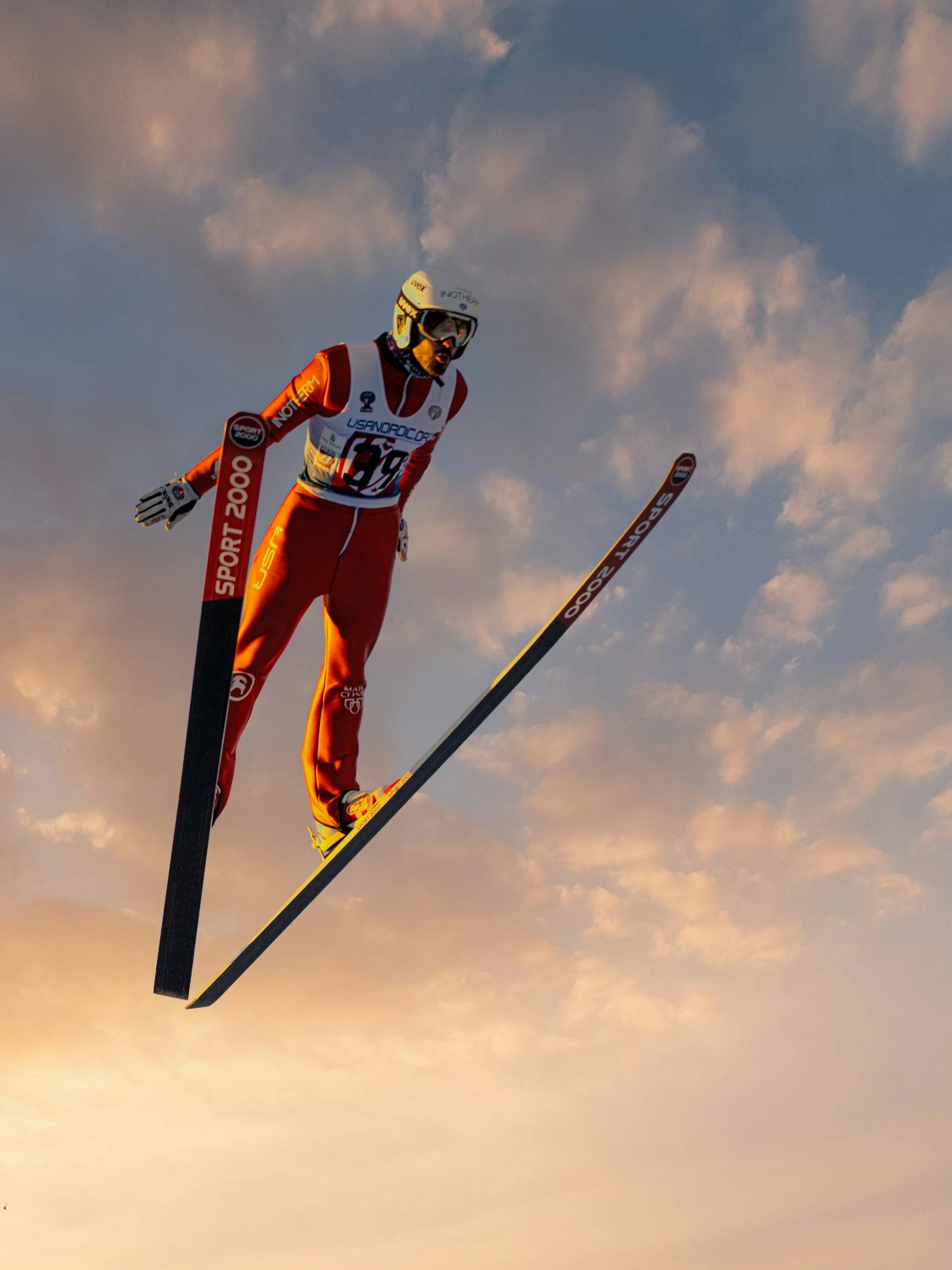
Olympic Physics
Teach your students simple physics using the Winter Olympics.
Newton's first law of motion, often called the law of inertia, states that an object at rest stays at rest, and an object in motion stays in motion with the same speed and in the same direction unless acted upon by an unbalanced external force.
External forces that athletes use: gravity, friction, lift
External forces athletes need to overcome: gravity, air resistance, friction
Pick a sport that you can watch in the Winter Olympics.
Watch a few competitions of that sport.
Write down: When is the athlete not moving? When is the athlete moving?
Notice how the athlete starts their motion. What is the external force applied to start the motion?
Notice how the athlete stops their motion. What external force are they using to stop their motion?
Experiment: Stack two equal sized coins or washers on top of each other. Slide a third coin into the bottom of the stack. Do all the coins move? Why does only the bottom coin move out of the stack.
Pile three or four equal sized coins or washers into a stack. Slide one coin or washer into the bottom of the stack. How many coins moved out of the stack? Why?
Only the coin/washer that has the force applied (the bottom one) will move.
How does the athlete in your sport use this?
Watch the special from NBC about Short track to explain how athletes understand this law of motion: https://www.youtube.com/watch?v=hfXvIr7fFes
Newton’s second law states that the acceleration of an object is dependent upon two variables - the net force acting upon the object and the mass of the object. F=ma (Force = Mass times Acceleration).
Pick a sport to watch in the Winter Olympics.
Watch what the athletes do to move forward or backwards. What are they using to apply a force? Do you think the athlete’s weight matters when competing in their sport? What does their weight influence?
Experiment: find four different balls around your house. Examples would be a baseball, golf ball, ping pong ball, and marble.
Record their weights or if you do not have a scale, list them from lightest to heaviest.
Create a starting line on a smooth surface. Set the ball at the starting line and then using a straw blow at the middle of the ball to get it to move forward.
Do you think it moved in slow, medium, or fast speed. Write the speed you think it moved next to the list you created for the weights. Do this for each ball.
Which ball moved the fastest? Which one moved the slowest?
Did you use the same amount of force through the straw. If you didn’t, try blowing on them again using the same force with each through the straw.
Why do you think the heavier ball moved the slowest?
F=ma The heavier the object, the more force is needed to move it. With the same force applied it will move slower because it is heavier (more mass).
Watch this NBC video on Newton’s second law in the Winter Olympics https://www.youtube.com/watch?v=GnzyNE_TmUI&list=PLRpUYjB1LkA97vS6sT745jwnak8-mBNFP&index=22
Newton's Third Law states that for every action, there is an equal and opposite reaction. When a force pushes down, there is an equal force pushing up (opposite direction). Think of a rocket ship. The fire pushes down during ignition and the rocket ship moves up (opposite direction) with equal force.
Pick a sport to watch during the Winter Olympics.
Where do you see the athlete’s dealing with this law of motion?
Experiment: blow up a balloon. Let it go and see which direction it flies. If it flew forward, where was the equal and opposite force? (The balloon flew forward because the air left the balloon in the opposite direction.)
How does this work with figure skating or other sports where the athletes jump into the air?

2025
New York
The Atlast Project →
“Communication was top-notch and the final outcome was even better than we imagined. A great experience all around.”
Former CustomerGet In Touch
If you're interested in working with us, complete the form with a few details about your project. We'll review your message and get back to you within 48 hours.